
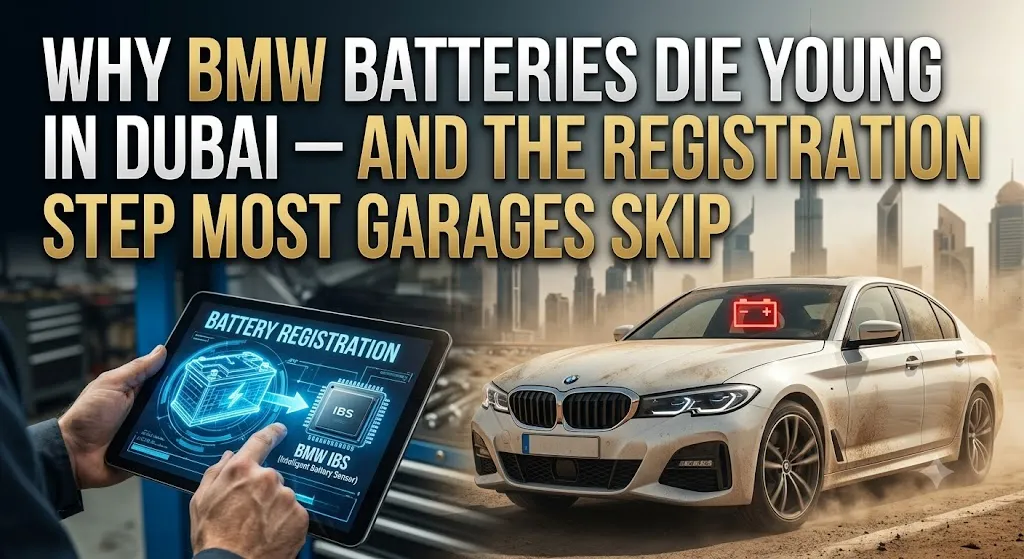
Battery failure is the number one roadside breakdown cause in the UAE, and BMWs have a particular relationship with the problem that catches many owners off guard. Not only do batteries die faster here than almost anywhere else on earth, but a BMW battery cannot simply be swapped like the battery in an ordinary car. Replace it without the correct procedure and the car may start and drive — while quietly mismanaging its charging system in ways that shorten the new battery’s life and trigger a parade of baffling electrical gremlins.
Understanding both halves of this story — why the climate kills batteries, and why BMW’s electrical architecture demands a proper replacement procedure — will save you money, breakdowns, and several frustrating conversations.
Heat Kills Batteries, Not Cold
The popular belief that batteries die in winter is a half-truth. Cold reveals a weak battery because starting demands peak current; heat is what actually destroys it. A lead-acid battery’s ideal operating temperature is around 25°C. For roughly every 8–10°C above that, the internal chemical degradation rate doubles. A battery sitting in a Dubai car park in August, in a black car, can stabilise above 60°C — meaning its plates are corroding and its electrolyte degrading at many times the design rate, twenty-four hours a day, for five months a year.
The practical result: a battery that would deliver five to seven years of service in Northern Europe typically delivers two to three years in the Gulf. This is true for every brand of car and every brand of battery. Owners who feel their battery “failed early” at 30 months are usually experiencing normal Gulf battery life, not a defective part.
BMW adds one more stress factor: modern BMWs are extraordinarily electronics-dense, and they do not fully sleep the moment you lock them. Modules stay awake for a shutdown period, telematics remain reachable, and comfort-access systems keep antennas polling. A healthy BMW draws a small, well-managed standby current — but a car driven only on short trips never fully replaces what starting and standby consume. Chronic partial charge causes sulfation, which permanently reduces capacity. A BMW used for two short school runs a day can kill a battery in eighteen months without anything being “wrong.”
The Warning Signs BMW Gives You
Because BMWs monitor battery condition through an intelligent battery sensor (IBS) clamped to the negative terminal, the car usually knows the battery is dying before the driver does — and it tells you, in its own language:
“Increased battery discharge” messages on the iDrive screen after starting. This is the car reporting that consumption while parked exceeded expectations — often the first sign of a fading battery (or, sometimes, a module failing to sleep).
Systems shutting themselves off. BMWs shed electrical loads to protect starting capability. The first casualties are typically the auxiliary features: seat heating cutting out, audio switching off while parked, start-stop refusing to operate. Start-stop that has quietly stopped working is the single most commonly ignored battery warning in the region.
Slow cranking after the car sits through a hot weekend. By the time cranking audibly slows, the battery is on its final stretch. In this climate, that stretch can be days, not months — heat failures are often sudden.
One-off electrical strangeness. Modern car electronics behave badly at low voltage. Random warning lights, windows forgetting positions, a tailgate that hesitates — low system voltage is the first suspect for any cluster of unrelated electrical complaints.
Why BMW Battery Replacement Is a Procedure, Not a Swap
Here is the part that generic garages and roadside battery services most often get wrong. Since roughly the mid-2000s, BMWs manage charging dynamically through the IBS and power management software. The car tracks the battery’s age, chemistry type, and capacity, and adjusts charging voltage and strategy accordingly — deliberately working an older battery differently from a new one, and charging an AGM battery on a completely different profile from a conventional flooded battery.
This creates two hard requirements when the battery is replaced:
Registration. The car must be told, through diagnostic software, that a new battery has been installed. Skip this, and the power management system continues running the ageing-compensation strategy meant for the old battery — typically overcharging the new one. In Gulf heat, an overcharged AGM battery gasses, dries out, and dies dramatically early. Unregistered replacement is the leading cause of “the new battery only lasted a year” complaints.
Coding for specification changes. If the new battery differs in capacity or chemistry from what the car expects — say, replacing an original 90Ah AGM with an 80Ah flooded battery because it was cheaper and available — the change must be coded, not just registered. Fitting a conventional flooded battery to a car specified for AGM (which includes virtually every BMW with start-stop) is a false economy regardless: AGM exists precisely because start-stop duty cycles destroy conventional batteries, and doubly so in this heat.
There are additional details a marque-experienced workshop handles as a matter of course: maintaining power to the car during the swap so that window, sunroof, and seat positions along with adaptations are not lost; checking for fault codes stored during the low-voltage period and clearing them properly; and testing standby current draw afterward, because sometimes the battery was the victim rather than the culprit.
When the Battery Is the Victim: Parasitic Drains
A meaningful share of “battery problems” in BMWs are actually sleep problems — a module that fails to power down and drains the battery overnight. Common culprits over the years have included telematics units, aftermarket accessories wired incorrectly (dashcams are a frequent offender in the UAE), tailgate modules, and infotainment components. The diagnostic approach is methodical: confirm the car’s standby current after it fully sleeps, and if it is excessive, isolate the responsible circuit. Replacing battery after battery without this test is a subscription, not a solution. If your BMW has eaten two batteries in two years, insist on a parasitic draw test before buying a third.
Practical Battery Survival in the Gulf
A few genuinely effective habits: park in shade or covered parking whenever you can, because battery temperature is destiny here. If the car sits for more than a week — common with owners who travel in summer — use a proper maintenance charger connected via the under-bonnet jump points, which keeps the battery full without fighting the car’s electronics. Give the car a proper 30-minute drive at least weekly if your usage is mostly short hops. Have the battery’s state of health tested at every service; a proper conductance test takes two minutes and predicts failure months in advance. And when replacement time comes — every two to three years, realistically — have it fitted, registered, and coded correctly as part of a proper bmw service dubai visit rather than swapped in a car park, so the car’s power management actually works with the new battery instead of against it.
Conclusion
Batteries are consumables everywhere, but in Dubai they are fast-moving consumables, and BMW’s intelligent power management turns replacement from a commodity job into a small technical procedure with real consequences when skipped. The owners who avoid breakdowns treat the pattern honestly: expect two to three years of battery life, watch for the car’s early warnings — especially start-stop going quiet — test rather than guess when batteries die young, and always, always register the replacement. It is a five-minute software step that determines whether your new battery lives its full Gulf lifespan or half of it.