
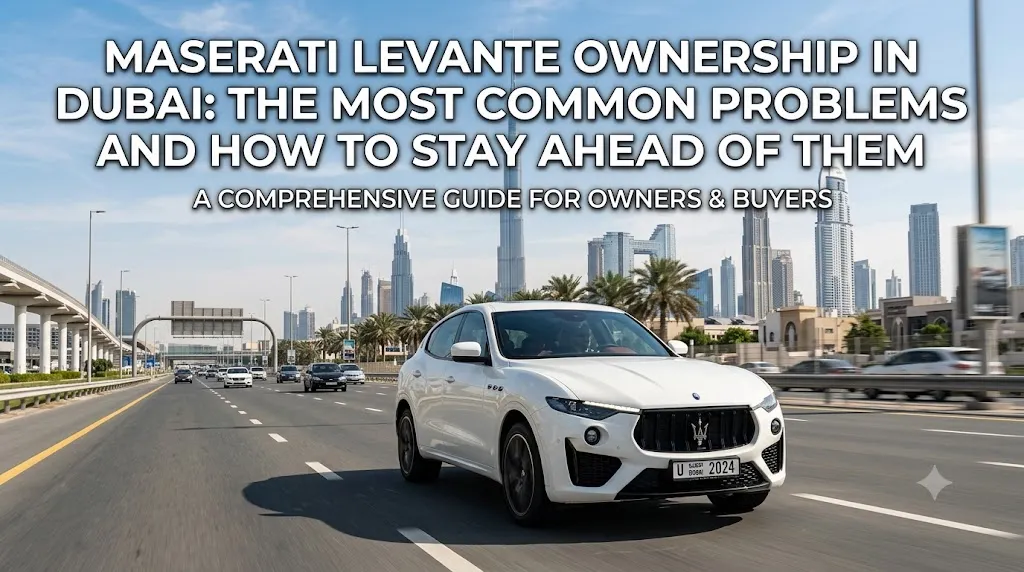
The Levante was the Maserati that made sense for the UAE. An SUV with genuine ground clearance for the occasional desert track, all-wheel drive, family space, and a Ferrari-built twin-turbo engine under the bonnet — it is no surprise the Levante quickly became one of the most common Tridents on Dubai roads. Many are now several years old and out of warranty, which means their owners are meeting the model’s known weak points for the first time, at their own expense.
The good news: the Levante is fundamentally a robust platform, sharing much of its engineering with the Ghibli and Quattroporte. The realistic news: it has a well-documented set of common issues, and Dubai’s climate accelerates most of them. Here is what every Levante owner in the UAE should know.
1. Cooling System: The Levante’s Number One Dubai Weakness
The Levante’s twin-turbo V6 (and V8 in the Trofeo) produces enormous heat, and the SUV body works the cooling system harder than the sedans — more weight, more drag, and many owners towing or driving in sand. The system’s plastic components are the weak link in Gulf heat:
- Expansion tanks develop hairline cracks and weep coolant, often visible as white crust.
- Thermostat housings and plastic hose fittings become brittle and fail.
- Radiator end tanks can split with age.
- Water pumps wear their bearings and seals, sometimes announced by a faint coolant smell or a whine.
A Levante losing coolant in August traffic goes from “small leak” to “overheated engine” alarmingly fast, and aluminium turbo engines tolerate overheating very poorly — head gasket and cylinder head damage are the expensive endgame. The defence is simple: annual pressure testing, proactive replacement of aging plastics, and absolute zero tolerance for low-coolant warnings.
2. Turbocharger and Boost System Issues
The twin turbos live a hard life in the UAE: intake air that is already hot, fine dust that shortens air filter life, and oil that degrades faster in heat — and turbo bearings are lubricated by that engine oil. Common symptoms include:
- Loss of power or “limp mode” under acceleration
- Whining or whistling that rises with engine speed
- Check-engine lights for underboost or overboost
- Blue-grey smoke on hard acceleration (worn turbo seals)
Many boost faults are not the turbos themselves but the supporting cast: cracked or loose charge pipes, tired wastegate actuators, or faulty boost sensors. This is exactly where proper diagnosis pays for itself — replacing turbochargers to fix a split hose is an expensive mistake that happens more often than it should at general workshops.
Prevention: shorter oil change intervals (8,000–10,000 km in the UAE), more frequent air filter changes, and letting the engine idle briefly after hard highway runs so oil can carry heat out of the turbo bearings.
3. Air Suspension Wear
Most Levantes ride on air suspension with adaptive damping — superb for combining SUV comfort with sports-car body control, and useful for raising the car on sand. In Dubai, the system’s rubber air springs age fast: heat and UV harden the rubber, and fine sand works into the folds of the air spring as it compresses, abrading the surface until slow leaks develop.
The classic symptom: the car sits lower on one corner after parking overnight, or the compressor runs longer and more often. Left alone, the leaking spring overworks the compressor until it burns out — turning a one-corner repair into a spring-plus-compressor repair.
What to do: if the car sags overnight, act immediately. Have the air springs inspected for cracking at every service, and wash sand out of the wheel arches regularly. Repair options range from genuine springs to quality OEM-supplier units; an experienced workshop will also test the compressor’s output and the valve block while the system is open.
4. Brakes: Big Performance, Big Wear
The Levante is a heavy, fast SUV, and Dubai driving — high speeds punctuated by hard stops — is exactly the duty cycle that wears brakes quickly. Owners commonly report steering wheel vibration under braking (disc thickness variation from heat), squealing, and faster-than-expected pad wear. On a vehicle of this weight and performance, brake condition is safety-critical: use OEM-quality pads and discs, and have the system inspected at every service. Brake fluid should be flushed every two years without fail — humidity degrades it, and a spongy pedal on a 2.1-tonne SUV is not something to tolerate.
5. Electrical and Battery-Related Faults
Like every modern Maserati, the Levante reacts to a weakening battery with a cascade of unrelated warnings: parking sensors, lane assist, suspension messages, infotainment reboots, phantom alarms. Dubai heat typically kills batteries within about two years. Before chasing any intermittent electrical gremlin, test the battery — it is the cheapest fix in the book and resolves a remarkable share of Levante electrical complaints. Beyond the battery, door handle sensors (the Levante’s flush handles), tailgate struts and modules, and infotainment software issues round out the common electrical list; many infotainment complaints are resolved with software updates rather than hardware.
6. Driveline and Transfer Case Noises
The Levante’s intelligent all-wheel-drive system normally sends power rearward and engages the front axle as needed. Owners occasionally report shudders or binding in tight, slow parking manoeuvres, or humming at highway speed. Causes range from tyres (mismatched wear front-to-rear confuses an AWD system — rotate religiously and replace in matched sets) to transfer case fluid that has aged in the heat. Fluid services for the transfer case and differentials are cheap insurance that many owners have never had done, because no service light will ever remind them.
The Common Thread: Heat, Dust, and Proactive Care
Read back through this list and a pattern emerges. Almost every common Levante problem in Dubai is either caused or accelerated by heat and dust, and almost every one is dramatically cheaper to address early: the weeping expansion tank before the overheat, the sagging air spring before the compressor burnout, the split charge pipe before the misdiagnosed turbo, the tired battery before the electrical wild-goose chase.
That is why the single most valuable asset a Levante owner in the UAE can have is a workshop that knows these vehicles intimately. A genuine maserati specialist dubai team sees these exact failure patterns week in, week out — they know to pressure-test the cooling system annually, to check air springs for Gulf-specific abrasion, to test the battery before condemning modules, and to look at charge pipes before quoting turbochargers. That pattern knowledge is the difference between paying for precise repairs and paying for educated guessing.
The Levante remains one of the most rewarding SUVs you can run in Dubai — genuinely fast, genuinely luxurious, and more capable than most owners ever discover. Maintain it on Gulf terms rather than European ones, choose expertise over convenience when something does go wrong, and it will repay you with years of dependable, characterful service.