
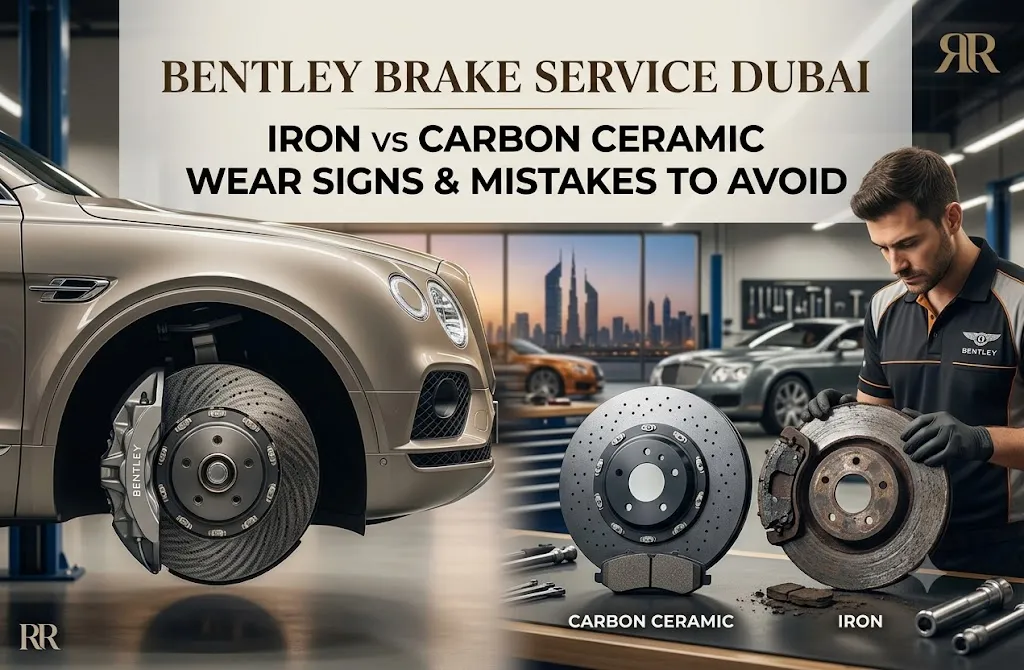
Stopping a Bentley is a serious engineering challenge. A Bentayga or Flying Spur can weigh well over 2.4 tonnes and reach 100 km/h in under four seconds — which means its brakes routinely convert enormous amounts of energy into heat. Bentley answers this with some of the largest braking systems fitted to any production car, including the famous carbon silicon carbide (CSiC) discs on higher-spec models, which at 440mm were among the biggest brakes in the world when introduced.
For owners in Dubai, where highway speeds, heavy traffic, and hot ambient temperatures combine into a uniquely demanding braking environment, understanding these systems — and how to maintain them properly — protects both your safety and your wallet. Here is the complete picture.
Iron or Carbon Ceramic: Know What You Have
Bentleys come with one of two brake systems:
Cast iron discs are standard on most models. They are enormous — typically 400mm+ up front with multi-piston calipers — and deliver superb stopping power. Their trade-offs: they are heavy, they wear as a normal consumable, and they are susceptible to heat-related judder if abused or fitted with poor-quality replacements.
Carbon ceramic discs (CSiC) are optional on Continental GT, Flying Spur, and Bentayga variants. They save significant unsprung weight, resist fade almost completely, and in normal road use can last an extraordinarily long time — often the life of the car. Their trade-offs: they are extremely expensive to replace if damaged or worn out, they require specific pads, and they must be assessed by weight and oxidation, not thickness, which most workshops cannot do.
Knowing which system your car has fundamentally changes the correct service approach — and the cost conversation.
The Warning Signs Dubai Drivers Should Watch For
1. Steering wheel vibration under braking
The most common Bentley brake complaint in the UAE. Usually caused by disc thickness variation on iron discs — uneven wear created by pad material transferring onto the disc face, often after hard braking followed by holding the brakes while stationary (exactly what happens exiting Sheikh Zayed Road into a traffic light). Machining is rarely appropriate on these discs; quality replacement is the proper fix.
2. Squealing or grinding
Light squeal on carbon ceramics, especially when cold or in reverse, is normal behaviour and not a fault. Persistent squeal on iron brakes usually means pads are at their wear limit or glazed. Grinding means metal-to-metal contact — stop driving and have the car recovered; the damage multiplies by the kilometre.
3. Long pedal or soft feel
Points to brake fluid condition, air in the system, or a hydraulic issue. Brake fluid is hygroscopic — it absorbs moisture from the air — and in Dubai’s humid coastal climate it degrades faster than in dry environments. Moisture-laden fluid boils under hard use, causing exactly the pedal fade you never want to feel at speed.
4. Brake warning lights and electronic faults
Bentleys monitor pad wear electronically and integrate braking with stability control, hill hold, and the electronic parking brake. Faults here need proper diagnostics, not guesswork — a “brake fault” message can be anything from a worn sensor wire to an ABS module issue.
The Mistakes That Cost Bentley Owners Real Money
Mistake 1: Cheap aftermarket discs and pads. On a car this heavy and this fast, budget friction components are a false economy and a genuine safety issue. They wear fast, judder early, and can’t handle repeated stops from highway speed. Genuine or premium OEM-grade components (from the same manufacturers who supply Bentley) are the only sensible choice.
Mistake 2: Wrong pads on carbon ceramics. Fitting iron-disc pads or aggressive aftermarket compounds onto CSiC discs can destroy discs worth more than a small car. Any workshop touching ceramic brakes must know the correct pad specification without hesitation.
Mistake 3: Skipping brake fluid changes. Bentley specifies fluid changes every two years regardless of mileage. In the UAE, treat that as a hard deadline. It is one of the cheapest services on the car and one of the most safety-critical.
Mistake 4: Ignoring caliper condition. Heat and dust age the caliper piston seals and slide components. A sticking piston drags the pad, overheats one corner, kills the disc, and hurts fuel economy. If one wheel is noticeably hotter than the others after a drive, or one pad set wears much faster, the caliper needs attention.
Mistake 5: Machining warped discs. Skimming removes material from discs that are engineered near their minimum functional thickness. On a Bentley it trades a proper fix for a temporary one and reduces the disc’s heat capacity precisely where Dubai driving demands more of it.
What a Proper Bentley Brake Service Looks Like
A thorough brake service by a competent workshop should include: measurement of disc thickness (or ceramic disc assessment by the correct method), pad thickness readings at all corners, brake fluid moisture and boiling-point test, caliper inspection and slide lubrication, electronic wear sensor checks, parking brake function test and calibration if needed, and a fault scan of the ABS/ESP system. When components are replaced, correct torque procedures and a proper bedding-in process for new pads and discs are essential — poor bedding is the number one cause of judder returning within weeks.
Dealer or Independent?
Brake work is an area where a skilled independent workshop offers exceptional value, because the parts themselves — genuine or OEM-grade — are available outside the dealer network at far better prices, and the labour procedures are well within reach of any true Bentley-experienced technician. Owners looking for a capable bentley garage dubai alternative to dealership pricing should simply verify three things: that the garage uses genuine or original-equipment-grade friction components, that it can handle the electronic side (wear sensors, parking brake service mode, ABS diagnostics), and that it road-tests and beds in the brakes properly before handover.
The Bottom Line
Brakes are the one system on your Bentley where “good enough” is never good enough. The encouraging news is that brake problems announce themselves early — a slight vibration, a faint squeal, a slowly lengthening pedal — long before they become dangerous or expensive. Respond to those first signs, insist on proper parts and procedures, keep the fluid fresh, and your Bentley will stop with the same effortless authority with which it accelerates. In Dubai traffic, that assurance is worth everything.