
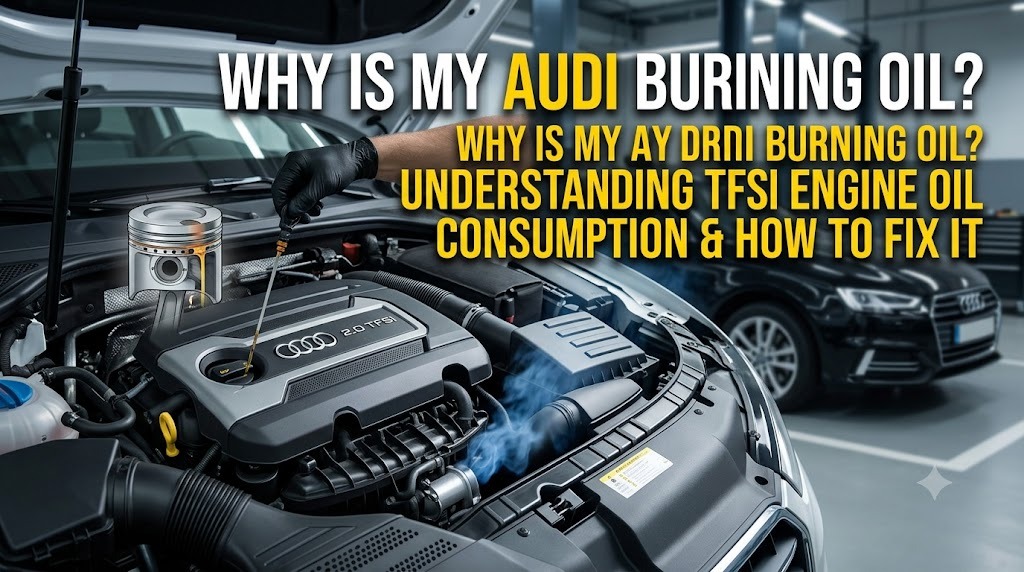
You check your Audi’s oil level and it’s low — again. You topped it up only 2,000 kilometres ago. There’s no puddle under the car, no visible leak, yet the oil keeps disappearing. If this sounds familiar, you’re experiencing one of the most widespread and misunderstood problems in the Audi world: excessive oil consumption in TFSI and FSI engines.
For owners in Dubai, where heat thins oil and accelerates every wear process, the problem tends to appear earlier and progress faster than in cooler climates. Here’s what’s actually happening inside your engine, which models are affected, and — most importantly — what genuinely fixes it versus what merely masks it.
What Counts as “Excessive” Consumption?
All engines consume some oil. Audi’s official position historically allowed up to 0.5 litres per 1,000 km as “within specification” — a figure most owners find shocking. In practice, a healthy modern Audi engine should use well under a litre between oil changes. If you’re topping up a litre every 1,500–2,500 km, something is wrong, and if it’s a litre every 1,000 km or less, the problem is advanced.
Keep records. Note the odometer reading every time you add oil. This simple log is the most useful diagnostic information you can hand a technician.
The Root Causes
1. Piston Rings and Drain Holes (EA888 Gen 1/2 — the Big One)
The 1.8 and 2.0 TFSI engines built roughly between 2008 and 2013 (fitted to the A4 B8, A5, Q5, and others) left the factory with low-tension piston rings and undersized oil drain-back holes in the pistons. Oil that should return to the sump instead lingers around the rings and burns in the combustion chamber. This is a design issue, not owner neglect — Audi revised the pistons and rings in later production, and the updated parts are the basis of the permanent fix.
Consumption from this cause is steady and progressive. It also fouls spark plugs (causing misfires), coats the catalytic converters in oil ash (eventually killing them), and dirties the intake with extra crankcase vapour.
2. PCV / Crankcase Breather Valve Failure
The positive crankcase ventilation valve sits on top of the engine and regulates crankcase pressure. When its internal diaphragm tears — a very common failure, accelerated by heat — the engine ingests oil vapour directly. Symptoms include a whistling noise from the engine, rough idle, oil around the valve itself, and a sudden jump in consumption. The good news: this is a relatively inexpensive bolt-on repair, and it should always be checked first before anyone quotes you for engine internals.
3. Valve Stem Seals
On higher-mileage engines and the V6/V8 units, hardened valve stem seals let oil seep down the valve guides into the combustion chamber. The classic tell is a puff of blue smoke on startup after the car has sat, which clears as you drive. Gulf heat hardens these seals faster than the engineers in Ingolstadt planned for.
4. Turbocharger Seal Wear
A worn turbo lets oil past its shaft seals into either the intake or the exhaust. Blue smoke under boost, oil pooled inside the intercooler piping, and whining noises point this way. It’s diagnosed by inspecting the charge piping — a five-minute check.
5. Simply the Wrong Oil or Extended Intervals
Running oil that doesn’t meet VW 502.00/504.00 spec, or stretching changes to 15,000 km in UAE heat, produces consumption on its own. Thin, sheared, oxidised oil slips past rings that would hold fresh oil perfectly well.
Diagnosis: Doing It Properly
Because the fixes range from a few hundred dirhams (PCV valve) to a major engine repair (pistons and rings), diagnosis is everything. A methodical workshop will:
- Check the PCV system first — the cheap, common cause.
- Inspect the turbo and charge piping for oil.
- Read fault memory and misfire counters — oil-fouled plugs leave fingerprints in the data.
- Perform a consumption test — fill to a marked level, drive a fixed distance, measure precisely.
- Run compression and leak-down tests, and use a borescope through the spark plug holes to look at the piston crowns and cylinder walls directly. Oil-washed piston tops confirm ring-related consumption.
Beware of any garage that jumps straight to “you need a new engine” or, at the other extreme, sells you endless oil additives. Additives do not repair piston rings.
The Real Fixes
PCV valve replacement — when that’s the cause, consumption often drops dramatically overnight.
Piston and ring replacement with updated parts — the definitive repair for affected EA888 engines. The engine is partially disassembled, the updated pistons/rings fitted, and while it’s apart, the intake valves are walnut-blasted clean and new seals fitted throughout. Done properly with genuine or OEM parts, this restores consumption to normal for the long term.
Valve stem seal replacement — on some engines this can be done without removing the cylinder head, using compressed air to hold the valves shut.
Turbo rebuild or replacement — with attention to the oil feed line, which can be restricted by baked deposits and cause the next turbo to fail too.
This is precisely the type of repair where brand experience pays for itself. An audi specialist dubai workshop that has performed dozens of ring jobs on these engines knows the updated part numbers, the torque procedures, the break-in requirements, and the difference between an engine worth repairing and one that’s better replaced — knowledge a general garage simply can’t match.
Living With It Until You Fix It
If a major repair isn’t in this month’s budget: check the oil weekly (a cold engine on level ground), keep a top-up litre of correct-spec oil in the boot, shorten your change interval to 8,000 km, and never let the level reach minimum — low oil in a hot climate is how a consumption problem becomes a seized engine.
Oil consumption is annoying, but it’s also one of the best-understood problems in the Audi world. With honest diagnosis and the right repair, these engines go on to deliver hundreds of thousands of reliable kilometres — even in Dubai’s heat.