
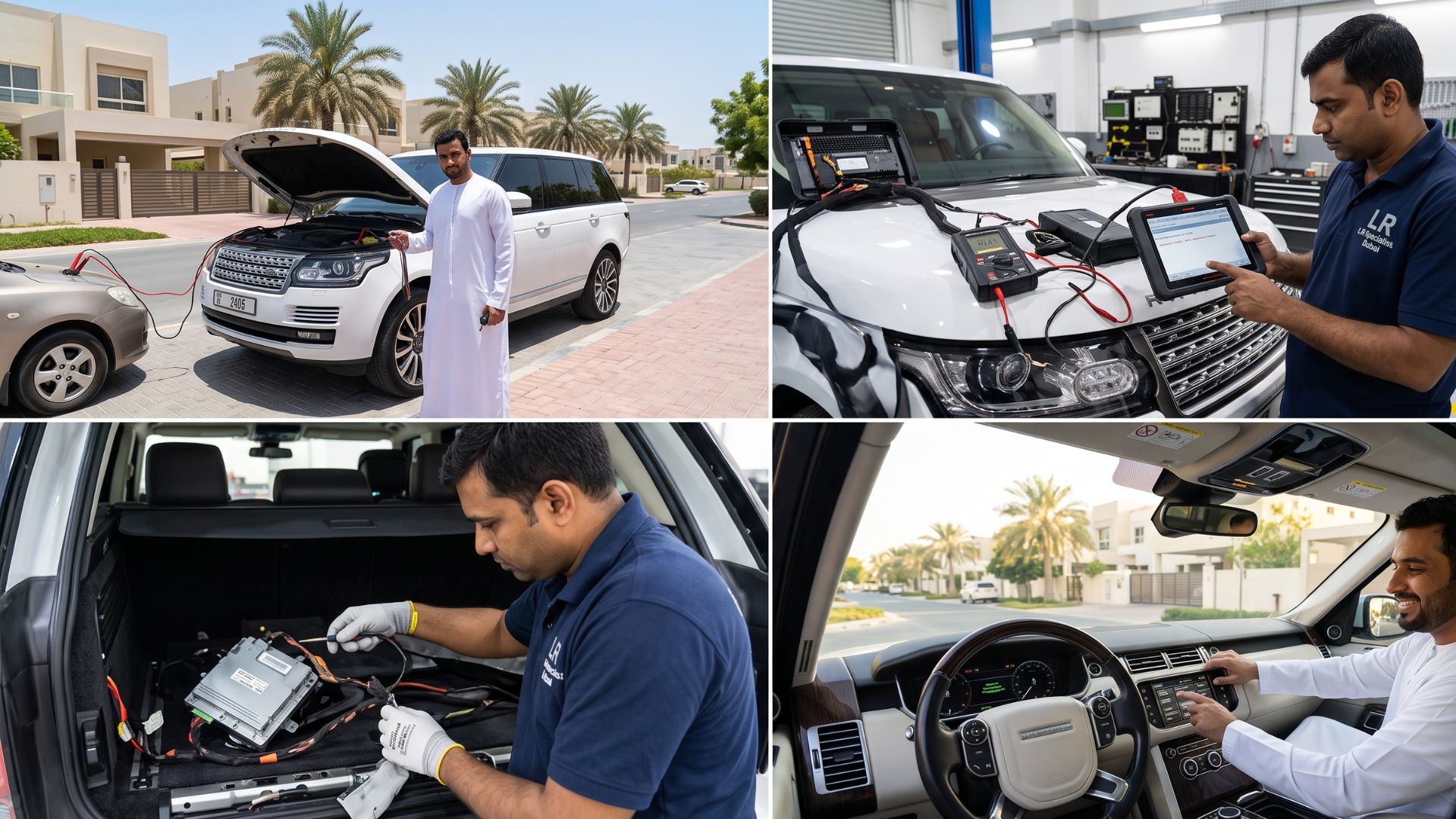
It is one of the most counterintuitive facts of car ownership in the Gulf: extreme heat is harder on a car battery than extreme cold. Many people associate dead batteries with freezing winters, but in Dubai, the scorching climate is a relentless battery killer. Combine that with the Range Rover’s notoriously power-hungry electronics, and you have a recipe for one of the most common — and most inconvenient — problems owners face: the car that simply will not start.
How Heat Destroys Batteries
A car battery generates electricity through a chemical reaction between its internal plates and the electrolyte solution surrounding them. Heat accelerates this chemistry — and not in a good way. High temperatures cause the electrolyte to evaporate, and they speed up the corrosion and degradation of the internal plates. The result is a battery that loses its capacity and its ability to hold a charge much faster than it would in a cooler climate.
In practical terms, a battery that might comfortably last five years in a temperate country may struggle to reach three years in Dubai. Many owners are caught off guard when a relatively young battery suddenly fails, not realising that the heat has been silently degrading it the entire time.
The Range Rover’s Power Demands
Range Rovers compound the problem with their sheer electrical complexity. Even when parked and switched off, the vehicle’s many control modules remain in a low-power standby state, drawing a small but constant current — what is known as a “parasitic drain.” A healthy battery handles this easily. A heat-degraded battery, however, can be drained flat by this standby draw, especially if the car sits unused for a few days.
The Symptoms of Battery Trouble
- Slow or laboured cranking when starting the engine
- The car failing to start entirely, especially in the morning
- Electrical systems resetting — clock, radio presets, settings
- A cascade of unrelated warning lights appearing on the dashboard
- Flickering lights or weak electrical performance
- The need for frequent jump-starts
The Phantom Fault Trap
One of the most important things to understand about Range Rover battery problems is how they masquerade as far more serious faults. A weak or failing battery can supply just enough voltage to confuse the vehicle’s electronics, triggering a bewildering array of warning messages across multiple systems. Owners — and poorly equipped workshops — sometimes spend significant money chasing these phantom electrical faults, replacing modules and sensors, when the actual culprit is simply a tired battery or an alternator that is no longer charging it properly. A proper diagnosis always starts by checking the battery and charging system first.
The Alternator Connection
The battery is only half the story. The alternator is responsible for recharging the battery and powering the vehicle’s electronics while the engine runs. In Dubai’s heat, alternators also work hard and can wear out. A failing alternator will leave the battery undercharged, leading to the same symptoms of drain and failure. Diagnosing battery problems properly means testing both the battery and the charging system together.
Skilled Range Rover repair in Dubai can accurately diagnose parasitic drains, test the charging system, and determine whether the fault lies with the battery, the alternator, or a misbehaving module — saving you from chasing phantom problems. For long-lasting replacement batteries and alternators rated for harsh conditions, trust verified Range Rover spare parts in Dubai every time.
The bottom line: Have your battery and charging system tested annually, ideally before the worst of the summer heat. A proactive test costs very little and spares you the frustration of being stranded with a Range Rover that will not start in 45-degree heat.